Technical Support:
158-7527-1139

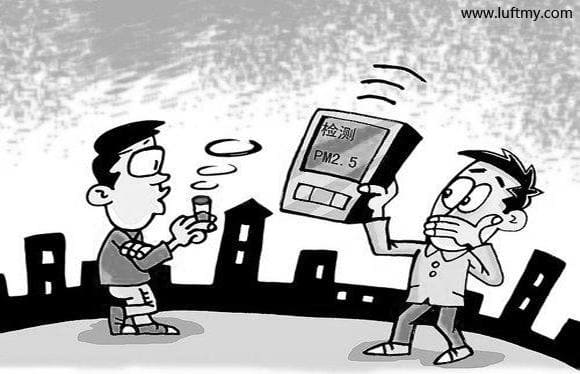
Humans spend approximately 80% of their time in indoor environments during production, daily life, and social activities. Whether at home or traveling in vehicles, air is invisible and intangible. So how can we determine the air quality around us?
PM2.5 refers to particles in the atmosphere with a diameter less than or equal to 2.5 micrometers, i.e., 2500 nanometers. These particles can remain suspended in the air for a long time, and higher concentrations indicate more severe air pollution.
Many fine particles in the air enter our body with every breath, but they are invisible to the naked eye. If a bright path is visible in the air, it indicates that a large number of unseen particles are constantly passing through our respiratory tract. If the concentration of harmful particles is too high, it can affect our health.
Observing with the naked eye alone is highly inaccurate, especially for PM2.5 dust particles. A laser sensor is a measuring device that uses laser technology for non-contact measurement. Laser sensors offer wide measurement range, high accuracy, strong anti-interference capability, and fast response. A laser dust sensor uses laser scattering to convert the scattered signal from PM2.5 particles into an electrical signal, which is amplified to display the measured dust concentration.
The LD09 laser particulate matter sensor module is a high-precision particulate concentration sensor based on the laser Mie scattering theory, capable of continuous collection and calculation of particle concentration distribution, converted into mass concentration, and output through a universal digital interface.
Guangzhou Lefmai, a particulate concentration sensor manufacturer, develops and produces laser air sensors that can be embedded into various instruments or environmental improvement devices related to airborne particulate dust concentration, providing timely and accurate concentration data.